
Daily Habits
The Morning Architecture of a Productive Man
Tobias Ashcroft · 12 February 2026 · 9 min read

Grooming, wardrobe, and personal care observed not as vanity but as the quiet infrastructure of a well-organised daily life. The evidence across this archive suggests that men who maintain a considered personal care routine report higher subjective well-being scores than those who regard it as optional.
The most consistent finding across the personal care notes submitted for this dispatch is the inverse relationship between the number of products in a grooming routine and the consistency with which the routine is followed. Men who maintained fewer than eight products in their daily grooming set completed their routine more consistently across the year, across travel, and across disrupted schedules than those whose routines required fifteen or more steps and products. The complexity of an elaborate grooming system becomes its own barrier; the simpler the set, the lower the activation cost.
The baseline set documented across the Marelo archive — the irreducible minimum that every contributor maintained regardless of other variation — consisted of: a face wash suited to skin type, a moisturiser with sun protection for daytime use, a quality shave or beard care approach, and a dedicated hand care product. These four categories represent the foundational layer that appears in every documented routine. Beyond this baseline, the additions varied considerably by contributor preference, skin type, and available time in the morning window.
What the documentation also revealed is that product quality within the baseline set has a significant effect on routine adherence. Several contributors noted switching from lower-cost essentials to higher-quality formulations and observing that their routine became something they looked forward to rather than something they endured. The sensory experience of a grooming routine — the texture, the scent, the tactile quality of applying something well-made — is itself a reinforcing mechanism. This is not an aesthetic argument; it is a behavioural one.
The editorial position of this archive, across the contributors whose skin care notes were reviewed, is that men's skincare in 2026 operates at a more sophisticated level than the broad conversation about it suggests. The men in this cohort were not following elaborate multi-step routines drawn from adjacent cultural sources; they had evolved simplified, practical approaches based on observation of what their own skin required across seasonal change.
Winter in Paris presents a specific challenge: heating-dried indoor air, cold outdoor air, and wind. The transition between these environments on a commute or during an outdoor fitness session creates a mechanical stress on the skin barrier that a daily moisturiser with restorative properties helps to address. Summer in the city brings UV exposure and humidity variation. The contributors who tracked their skin across the full year noted significant improvement in skin clarity when they adjusted their product selection seasonally — a heavier emollient in winter, a lighter serum-based formulation in summer — rather than maintaining a fixed routine regardless of season.
"A grooming routine is not a statement about character. It is a decision about how much attention one wishes to give to the face one shows the world."
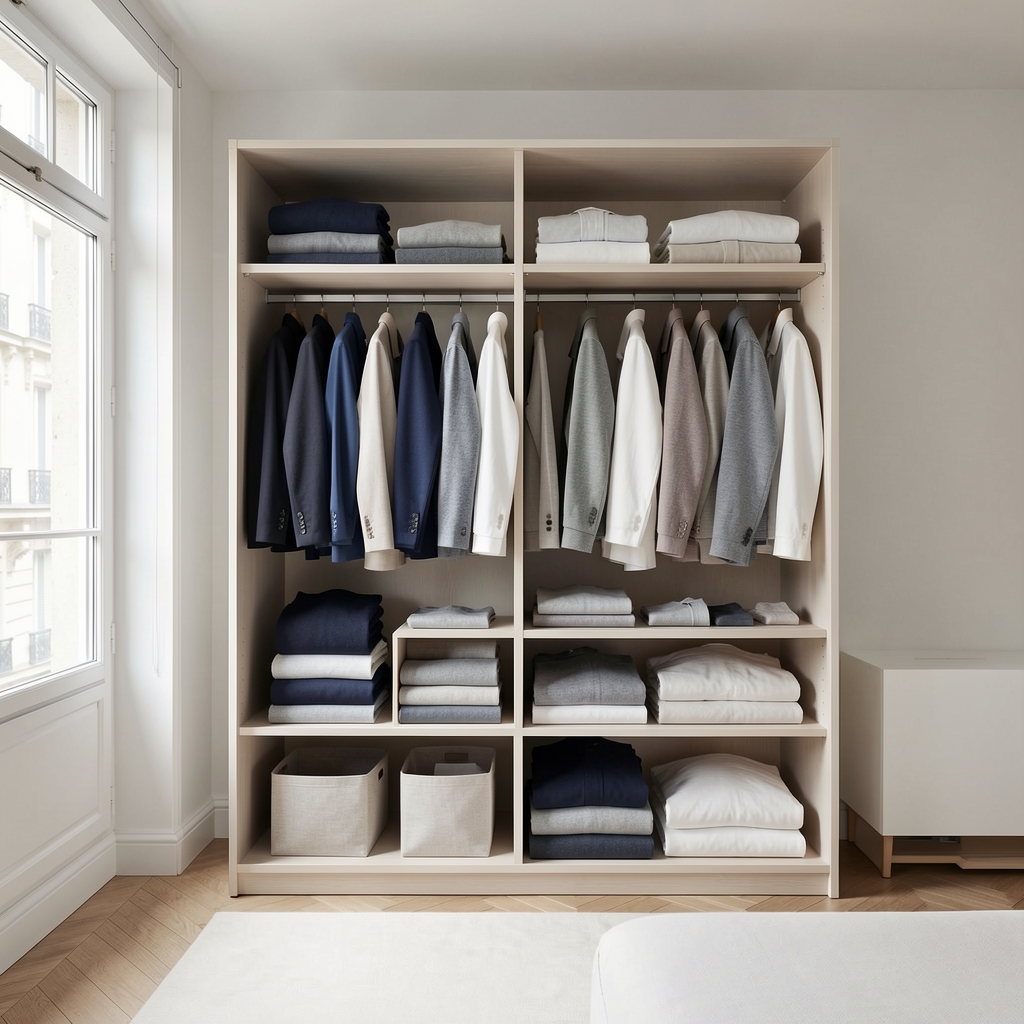
Wardrobe planning emerged as the most discussed subject across the personal care field notes, and the most conceptually unified. Every contributor who offered detailed wardrobe notes used language of resolution — the wardrobe as a solved problem, a completed system, a set of decisions made once and not revisited without cause. This is distinct from the language of fashion, which concerns itself with novelty and currency. The men documented here were building wardrobes in the way an engineer builds a toolkit: selecting for quality, function, and internal coherence.
The seasonal wardrobe audit — a review conducted at the start of each season, removing items that no longer fit, no longer function, or no longer align with the wardrobe's internal logic — appeared in five of the eight wardrobe-focused submissions. The audit typically took between thirty minutes and an hour, and contributors described it as producing a sense of clarity that extended beyond the wardrobe itself. The observation aligns with broader notes in the archive on the relationship between environmental order and cognitive focus: a resolved wardrobe reduces the number of small decisions made in the morning, which preserves deliberate attention for more consequential work.
Several contributors described their wardrobe organisation around a neutral colour palette — deep navy, off-white, charcoal, stone — with one or two considered accent pieces per season. This approach reduces the friction of assembling combinations while allowing for sufficient visual variety not to feel monotonous across a working week. It is a practical solution rather than an aesthetic statement, and it appeared independently across contributors from different professional and personal backgrounds.
The personal care routines documented for this dispatch rarely stood alone. In almost every submission, grooming was positioned as one component of a broader morning architecture — following physical activity, preceding the first meal, preceding the working day's first engagement. Its placement within this structure was not incidental. Contributors described the grooming routine as the final preparatory step before engaging with the external world: a transition point between the private morning and the public day.
The duration of the grooming component in these morning architectures ranged from seven minutes to twenty-five. The shorter routines were notably more consistent across disrupted schedules; the longer ones were maintained on ordinary days but compressed or partially skipped under time pressure. The editorial note is a familiar one: shorter, well-curated routines survive disruption better than comprehensive ones. The seven-minute practitioner who always completes his routine covers more cumulative ground across a year than the twenty-five-minute practitioner who completes his when conditions are favourable.
This observation extends to the wardrobe. The decision to lay out the following day's clothing the night before — cited by four contributors as a deliberate practice — consistently reduced morning time-to-ready by eight to twelve minutes and eliminated what one contributor called "the dressing fog": the low-grade decision fatigue that accumulates from small, unresolved morning choices. The practice requires two minutes the evening before and saves considerably more the morning after. The transaction appears in the notes as obviously worthwhile; the only question is why it is not universally adopted.
The term "modern gentleman" carries weight that the contributors to this dispatch approach with some caution. The word carries associations — social class, performance, archaic convention — that do not map precisely onto what the archive documents. What emerges from the notes, instead, is something simpler and more durable: the man who has made considered decisions about his personal presentation, not in deference to external expectation but in service of his own sense of order and self-respect.
The men documented in this archive groom well, dress thoughtfully, and maintain their personal presentation with consistency. None of them do so to impress others in a direct sense; all of them describe the practice as one that affects how they feel — their sense of readiness, their sense of ownership of the day. The external effect is secondary and incidental. The internal effect is primary and reliable.

Phoebe Linwood is a Paris-based writer whose work covers the intersection of personal practice, self-presentation, and everyday quality. Her contributions to Marelo Quarterly focus on the material culture of the considered daily life.
Browse Further Dispatches →