
Daily Habits
The Morning Architecture of a Productive Man
Tobias Ashcroft · 12 February 2026 · 9 min read

A four-season account of how outdoor strength work adapts, holds, and sometimes reinvents itself across the calendar year — drawn from field notes submitted by six contributors documenting their outdoor fitness practice across Paris and the Île-de-France region.
Autumn arrived in the documented routines not as a disruption but as a reset. The long evenings of summer had, for several contributors, expanded their outdoor sessions into loosely bounded affairs — running past the agreed-upon distance, adding a circuit at the end of an already-long session, training at variable times depending on the day's heat. September and October imposed natural constraints: shorter light windows, cooler ground under bare hands on outdoor bars, the practical compression of the training hour into something more deliberate.
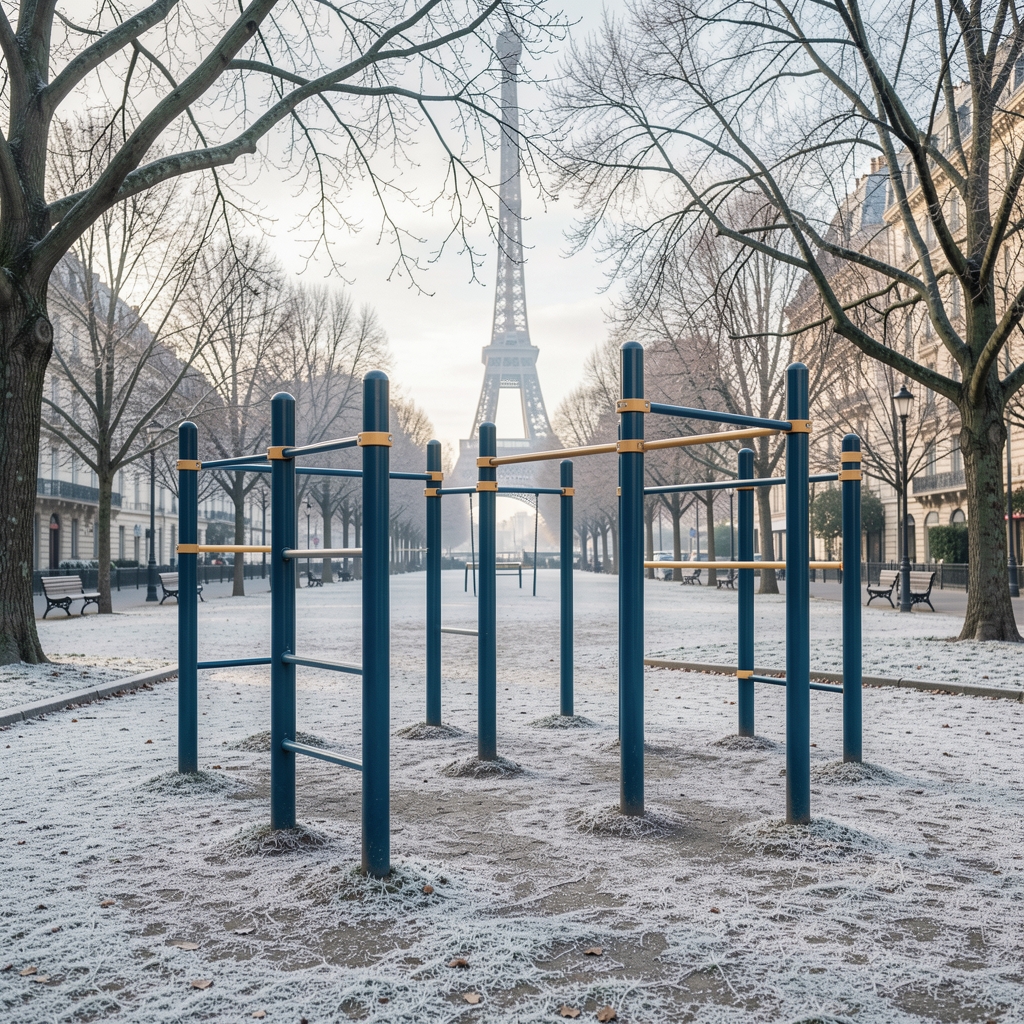
Three contributors documented their autumn sessions in the Bois de Vincennes and Parc de Sceaux. The pattern that emerged across their notes was a shift from volume-led training to intensity-led training — not a planned periodisation, but a natural response to the narrowing time window. Fewer sets, more focused effort within each. The outdoor calisthenics structures scattered through Paris's parks provided the framework: pull bars, parallel bars, flat surfaces, benches. The toolkit is modest; the sessions within it can range from maintenance-level effort to genuinely taxing work depending on the practitioner's intent.
What the autumn field notes most consistently noted was an increase in what one contributor described as "session clarity" — the sense of going into a session with a specific set of intentions and completing exactly that, rather than following the looser summer mode of improvised extension. The seasonal constraint had functioned as a focusing device.
The winter period — from mid-November through to late February in the documented cohort — presented the most varied response. Two contributors continued outdoor-only training without modification; four made selective indoor substitutions for the coldest weeks; two shifted almost entirely indoors for the duration of the winter months. No single approach demonstrated clear superiority in terms of sustained output or body composition tracking across the period, but the contributors who maintained some outdoor component — even reduced to two sessions per week — reported consistently higher engagement with their overall fitness practice than those who transferred entirely to indoor settings.
The outdoor-only practitioners offered the most detailed winter field notes, which suggests that the additional environmental challenge — cold hands, harder ground, reduced grip security in the frost — demanded a higher level of conscious engagement with each session. The body responds differently to training in cold conditions; the cardiovascular load at any given intensity level is higher, and the warm-up period must be regarded as genuinely preparatory rather than as a formality. Both outdoor-only practitioners noted that their sessions were shorter in winter but felt more effortful, and their subjective recovery ratings were higher in January than in October.
"January is the most honest month for an outdoor practitioner. You find out quickly what was routine and what was preference."
Body composition tracking across the winter period showed a consistent pattern among the four contributors who measured consistently: a modest decrease in lean mass for those who shifted fully indoors, a maintenance of lean mass for those who maintained outdoor sessions, and a modest increase for the two outdoor-only practitioners. The differences are not dramatic enough to be prescriptive, but they align with the general finding in published nutritional research that environmental variation in training is associated with greater metabolic adaptation than training in controlled, constant conditions.
Nutritional habits during the winter period also diverged in ways that the contributors themselves attributed to their training environment. Those training outdoors consistently reported a stronger appetite for protein-rich meals in the hours following a session, and higher incidence of deliberate meal preparation the evening before a planned outdoor session. The preparation appeared to be partly practical — the knowledge that a cold morning session requires proper fuelling — and partly ritual, a form of pre-commitment to the session itself.
March brought a marked shift in contributor energy and session documentation. The light returned gradually; sessions lengthened by ten to fifteen minutes without deliberate intention; the notes became more detailed and more ambitious in tone. Spring in the archive functions as a natural rebuilding window — the period when adaptations accumulated through winter's more restrained training are tested against an expanding schedule of outdoor work.
Several contributors introduced new movement patterns in spring: trail running sessions in the forests south of Paris, cycling alongside strength work, morning rowing on the Seine for one contributor with access to a club. The diversity of spring training modes reflects the season's expansiveness — a sense of available space and time that winter contracts. The editorial note here is to preserve some of the winter's discipline during this expansion. The contributors who managed spring volume most effectively were those who introduced new modes alongside, not instead of, their established strength work.
Active recovery work — mobility sessions, deliberate walking without pace targets, reduced-intensity weeks — appeared more frequently in spring notes than in any other season. This may reflect a natural response to the higher training volume, or it may reflect the season's more varied activity menu, which makes lower-intensity movement easier to build in without it feeling like a compromise. Either way, the distribution of intensity across a training week was more balanced in spring than in any other season across the documented cohort.
Five of the six contributors described weekend physical activity that extended beyond their regular training framework — weekend long hikes in Fontainebleau forest, cycling routes through the Chevreuse valley, day trips to the coast involving sustained walking on variable terrain. These were not classified as training in the contributors' own logs; they appeared under headings like "Sunday" or "weekend" rather than "session". Yet their cumulative contribution to weekly activity volume was significant, and two contributors identified them explicitly as the element most responsible for their sustained fitness engagement across the full year.
The distinction matters. Weekend adventures — physical days that are structurally recreational rather than structured training — fulfil a different function in the overall fitness architecture. They maintain a connection between physical effort and environmental engagement that purely programmed training can lose over time. The body gets strong in the gym or on the pull bars; it gets resilient in the forest, on the hillside, on the long coastal walk. The combination of structured and unstructured physical activity across a week appears, in the documented field notes, to produce a more durable engagement with overall fitness than either type alone.

Tobias Ashcroft is a contributing editor at Marelo Quarterly covering daily habits, fitness documentation, and work-life balance. His field notes are drawn from four years of observational writing across Paris and London.
More from Tobias →